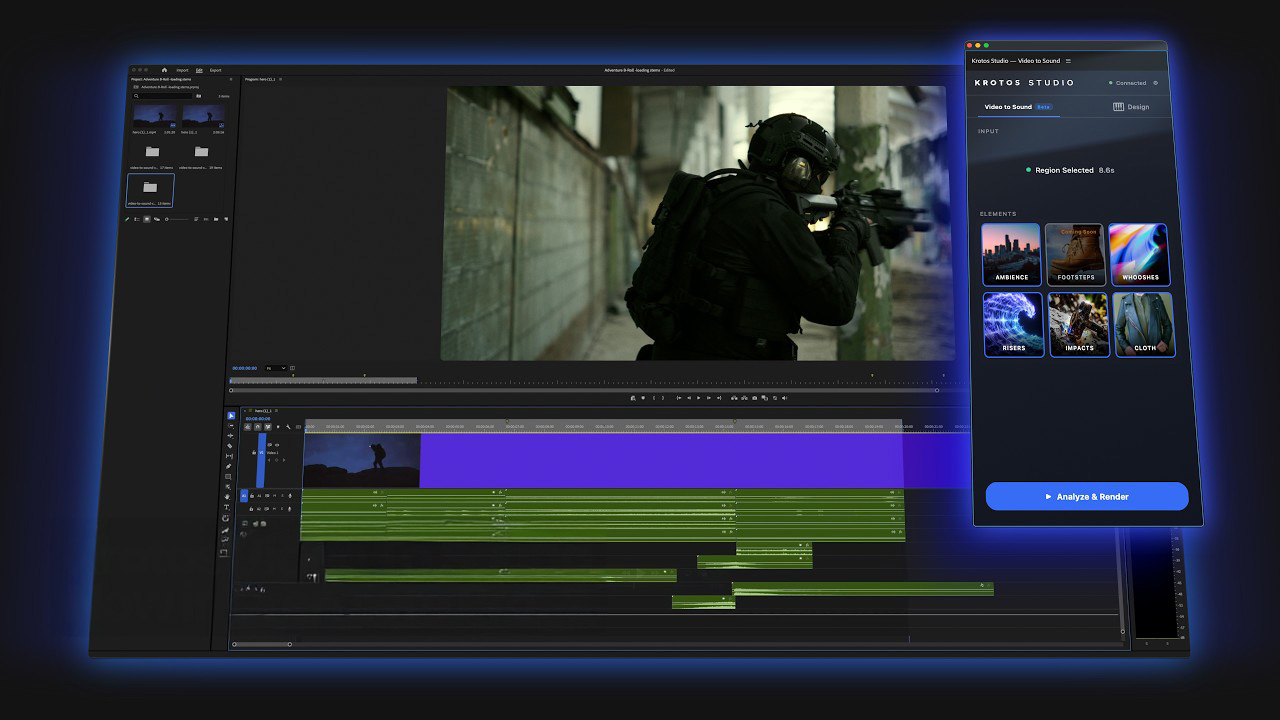

Krotos Audio has launched a new plugin for Adobe Premiere Pro that places synced sound effects onto a video timeline automatically. No audio knowledge required.
The sound design community is divided.
Key Takeaways
- Krotos Video to Sound is a native Adobe Premiere Pro plugin that analyses a selected timeline region and places synced sound effects automatically.
- It draws from a library of more than 100,000 real, professionally recorded sounds rather than generative audio.
- Six sound element types are available at launch: ambiences, whooshes, transitions, risers, impacts and cloth. Footsteps and spot effects are in development.
- Krotos positions the tool at video editors, content creators, and sound designers looking to speed up early-stage work on a sound pass.
- The sound design community has responded with widespread anger, calling it a betrayal by a company that built its reputation on professional post production tools.
- The deeper concern is not the current quality of the plugin but what it signals for entry-level jobs in audio post production.
TL;DR — Quick Summary
Krotos Audio's Video to Sound integration for Adobe Premiere Pro is an AI-assisted sound design plugin that analyses a selected region of video footage and automatically places synced sound effects from a library of over 100,000 professionally recorded sounds. This article covers how the plugin works, what sound element types it supports at launch, and how it fits into the wider Krotos Studio platform. It documents the widespread backlash from the professional sound design community, drawing on responses from Facebook and Reddit, and outlines the two core concerns: that Krotos has pivoted away from its professional user base, and that tools like this threaten entry-level positions in audio post production even if they leave senior practitioners largely unaffected. The article presents both critical and measured perspectives from working professionals, and examines what the long-term implications may be for the industry.
What the Plugin Actually Does
The plugin runs inside Premiere Pro through the UXP Plugins panel. Editors select an in and out point on the timeline, choose a sound style, and hit Analyse and Render. Sound effects are placed automatically. No exporting. No switching apps.
At launch, it covers six categories: ambiences, whooshes, transitions, risers, impacts and cloth. Footsteps and spot effects are in development and will arrive as a free update for subscribers.
Krotos is clear that the AI is assistive, not generative. Every sound was recorded by professional sound designers from a library of over 100,000 recordings. The AI selects and places them. It does not synthesise them.
The company also says it does not use customer video or audio to train its models.
The plugin is part of Krotos Studio, which also runs as a standalone app and as a VST, AU and AAX plugin inside a DAW.
What Krotos says: AI-assisted, not generative
What professionals say: Still displaces human judgment at the placement stage
What Krotos says: Professional sound without specialist knowledge
What professionals say: Contradictory — you cannot have both at once
What Krotos says: Speeds up early stages for sound designers
What professionals say: Removes the entry-level work that trains new editors
What Krotos says: Does not use customer audio to train AI
What professionals say: Some remain sceptical of this claim
What Krotos says: Footsteps and spot effects coming soon
What professionals say: Expanding coverage only increases the threat
"A complete backstab"
The announcement landed badly. On Facebook, where the post generated dozens of responses, the reaction ranged from disappointed to outright hostile.
The dominant feeling was not surprise. Several people said they had seen this coming. It was betrayal. Krotos built its name selling tools to working sound professionals, and many of those same professionals now feel the company is using that credibility to sell past them to a different audience.
The marketing framing made things worse. Krotos positioned the plugin as useful both for video editors with no audio background and for professional sound designers wanting to speed up early-stage work. To most in the community, that reads as trying to have it both ways.
Re-recording mixer Rico Casazza did not hold back: "The real issue is that Krotos is actively courting picture editorial to bypass the sound department entirely. This type of generic automation completely misunderstands the art of post-production. Sound design isn't just about fast placement or ticking a box; it requires taste, human judgment, and unique intent... Krotos built its name on our community, and pitching a 'no specialist audio knowledge required' tool inside Premiere is a complete backstab to the professionals who supported them."
Sam Hayward kept it short: "Remember, if you're using ai for simple tasks, ai is using you to learn complex tasks."
The Quality Debate
sNot everyone thinks the current version warrants this much alarm.
The plugin launched with a narrow feature set. Early testers described the output as inconsistent. The AI's ability to match sound to picture drew repeated criticism for being unreliable and creatively blind.
Sound designer Mikko Roisko spotted a contradiction in Krotos' own marketing. The company describes the tool as suitable for "video editors who want professional sound without specialist audio knowledge" and simultaneously for "sound designers looking to accelerate the repetitive early stages of a sound pass."
His response: "I'm confused, does it produce 'professional sound' or just help with preliminary cutting in early stages?"
It is a fair question. And it goes to the heart of why the community is arguing on two tracks at once: what the tool does now, and what it will do eventually.
"It will get better. That's the point."
The more measured voices are not dismissing the concern. They are placing it further down the timeline.
The structural argument, made clearly in a widely-shared thread on Reddit's r/sounddesign, is this: the tool does not need to replace experienced sound designers to cause real damage. It needs to get good enough for clients who never cared about quality in the first place.
That is a much lower bar.
The work that sits below that bar — the corporate videos, the low-budget unscripted projects, the fast-turnaround content where the client wants the box checked — has historically been the entry point for people building careers in audio post.
Sound designer Steven Ghouti put it plainly: "The issue is that it'll be removing entry-level sound editor positions where the younger generation should normally be able to learn their trade... people working in corporate films, or stuff like that, will say 'it's good enough for me', albeit being shit, and that takes an opportunity away for someone to work on it. It's a totally back-stabbing action to take from that company, after having taken the cash of so many sound people to get where they are."
Others made the same point with less heat. Andres Boulton: "This is not going to replace us - yet. It's not great, far from it... But it's getting better. And for some clients it doesn't have to be 'amazing', just good enough and when that happens, a trend will start and many of us will end up competing -fiercely- for the few better gigs."
The consensus is not that the tool is good enough now. It is that the direction of travel is clear, and the entry-level market is exactly where the damage lands first.
Where Krotos Actually Stands
Krotos is not a new name in audio post. The company built its reputation on tools used in major productions, including Game of Thrones, Stranger Things and Star Trek. It has a genuine history of serving professional users. That history is part of why the response has been so sharp. The professionals pushing back are not strangers to the brand. Many of them are customers.
The feeling, expressed across Facebook and Reddit, is that Krotos has looked at its professional user base, decided there is a bigger market elsewhere, and moved on.
Nick Granville-Fall said it directly: "I think since most of the audio community doesn't use them they are pivoting their software to editors. 'You don't have to leave Premiere' that says it all. Don't bother sending the project to a sound specialist."
Not everyone sees it that way. Some professionals argue that a rough placement tool is just another item in the kit — useful for temp work, easy to override. Re-recording mixer Nathaniel Reichman questioned the whole emotional register of the debate: "I don't want to sound provocative, but we're the industry that adopted sound automation, ADR, green screens, drum machines, CGI and LED volumes. Why are we drawing a line here?... I don't care what tools that person uses. I need that person to deliver a killer, well-organized set of tracks, and I need to be able to call or text that person if something is wrong."
Fair points. But they sidestep what is actually bothering most people. The debate is not about whether the tool can do the job of a senior sound designer. It is about whether enough clients will decide it can do the job of anyone at all.
What Comes Next
Krotos has said footsteps and spot effects are coming as free updates, with support for editors beyond Premiere Pro planned. The plugin is free to try and included across Studio, Pro and Max subscription tiers.
The real question is what this looks like in two or three years, once the tool has improved and competitors have followed.
The concern is not AI reaching some threshold of creativity. It is AI getting good enough for clients who never cared about quality in the first place.
That bar is lower than most people want to admit.
Frequently asked questions
What is Krotos Video to Sound?
Krotos Video to Sound is an AI-assisted sound placement tool that analyses a region of video footage and automatically places synced sound effects from a library of over 100,000 professionally recorded sounds. It runs as a native plugin inside Adobe Premiere Pro through the UXP Plugins panel, and is also available as a standalone application and as a VST, AU and AAX plugin inside a DAW.
Does Krotos Video to Sound use generative AI?
No. Krotos has been clear that the tool is AI-assisted rather than generative. The AI selects, combines and places sound effects, but every sound in the library was recorded and refined by professional sound designers. Krotos states it does not use customer video or audio to train its AI models.
What sound element types does the Premiere Pro plugin support at launch?
At launch, the plugin covers six categories: ambiences, whooshes, transitions, risers, impacts and cloth. Footsteps and spot effects are currently in development and are expected to be added at no extra cost for subscribers.
Why are sound designers angry about the Krotos Premiere Pro plugin?
The community anger centres on two things. First, Krotos built its name selling tools to professional sound designers and now appears to be pivoting toward a non-specialist market, which many see as a betrayal. Second, there is a structural concern that tools like this will erode entry-level positions in audio post production, removing the starting point for people building careers in the field even if they leave experienced professionals largely unaffected.
Will Krotos Video to Sound replace professional sound designers?
For high-budget productions that require creative sound design, the current consensus is no. But the concern in professional circles is not about replacement at the top. It is about the low-budget, fast-turnaround work that has historically served as the entry point for people starting careers in audio post. That category of work is exactly where tools like this are already capable enough to satisfy clients who prioritise speed and cost over quality.
Is the Krotos Video to Sound plugin any good?
Early feedback from professionals who used the beta is mixed to negative. Several described the output as inconsistent and limited. The plugin currently covers a narrow range of sound elements and the AI's placement logic has been criticised for lacking creative intent. Most commenters acknowledge the quality will improve over time, which is the root of the concern rather than the current output.
How is Krotos Video to Sound priced?
The plugin is free to try and included across Krotos Studio's paid subscription tiers (Studio, Pro and Max). Higher tiers include greater usage allowances. It is part of the wider Krotos Studio platform, which also includes a standalone application and DAW plugin versions.
What This Means
What happens to Krotos depends partly on whether the community backlash has any real commercial weight. Several professionals have publicly said they are done with the company. Whether that translates into lost revenue, or whether Krotos has already calculated that its future lies with a different audience entirely, remains to be seen.
For sound professionals, the craft still matters. Intentional, creative sound design for picture is not something a first-pass placement tool can replicate. But the entry-level market is a different story.
And that is a conversation the industry needs to have before the moment has already passed.
Browse our library of professionally recorded sound effects at 344 SFX, designed by practitioners for practitioners.